Showing posts with label Japan. Show all posts

3.24.2024

Finger 5 Was J-Pop’s Sugary Sweet Answer to The Jackson 5


To read my latest piece published in Counter Arts, zip on over to Medium by clicking on my friends link here. 

3.23.2024

When You Finally Get Around to Seeing Your Name in the End Credits 5 Years After the Film’s Release

“By the time that 80s and 90s babies (see Millennials) were cutting their teeth on later broadcast imports like Mighty Morphin’ Power Rangers, Dragon Ball, Sailor Moon, and Pokemon, grown Gen-X geeks like me were booking airplane tickets or driving to places of fan pilgrimage near and far, like the already mentioned G-Fest, or Anime Expo in Los Angeles, and San Diego Comicon.” 

_____________________________________

 Yooooo, you still come back to check out this old blog? You rock!! 

To read my latest piece in Fanfare, zip on over to Medium by clicking here on my friends link. (I mean, if  you're here, you must be a friend.) ^_^ 

3.19.2019

Craving in Vain?

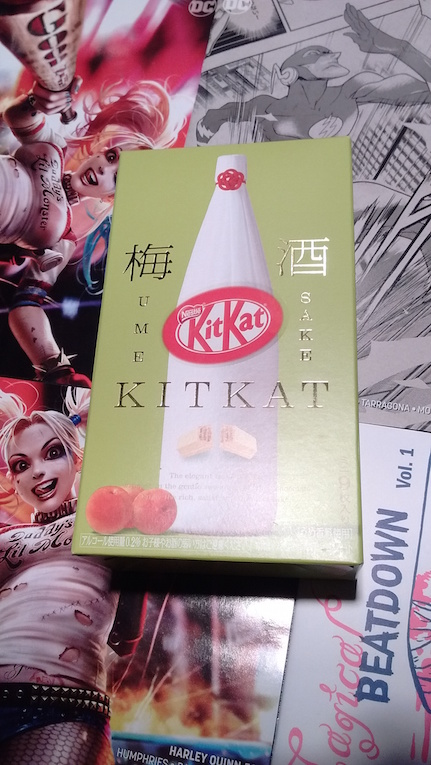
When you've been craving – in vain – Japanese Kit Kats and then visit a shop that you've never been to before that has shockingly little in the way of comics, but two boxes of the Japan Airport EXCLUSIVE white chocolate Ume (plum) Sake Kit Kats sitting on the counter. Yum.

Anywho, not like you asked, but this past weekend was a good weekend, True Believers. In addition to these tasty imported goodies that I picked up at the previously mentioned but unnamed shop (Otaku Hobbies), I stopped into Amazing Fantasy, my regular shop here in the Chicago burbs, where I grabbed up two copies of Harley Quinn #59, a copy of the small press mini comic Magical Beatdown #1, and some other goodies (not pictured). 

Over at Half Priced Books, I snagged a copy of Flash #59 for $2–half of the $3.99 retail price, because...Half Priced Books! I don't even read Flash comics, but I saw this uber cool manga-inspired variant cover by artist Karl Kerschl online a couple months ago and made a mental note to snag a copy whenever I ran across one in the wild. So I did. ^_^


6.19.2015

[Archives] Vapors All-City Magazine – Tokyo Issue, Dec-Jan 2003


Features: Ipath Japan//DGK SF-Tokyo//Lui Araraki//Street artist Naomi//Def Jam Japan//Large Professor

6.16.2015

Work in Progress – Chico Roland Filmography


I'm not sure if I'm gonna use this in the essay collection that I'm working on, but I've been putting together a filmography on the prolofic African-American presence in old Japanese films and TV shows of the 60s, 70s and 80s known as Chico Roland. If you've seen Gamera vs. Monser X (1970), or Sonny Chiba's The Streetfighter (1974), then you've seen Roland in what are certain to have been his most widely viewed bit parts in the English speaking world. 

With regard to his filmography, it may actually end up being posted on YKFS when it's done, and I may run with something else on him for the book. In the meantime, shared above is the promo poster for the 1968 film, Great Insect War (aka Genocide), one of the thirty-something flicks in which Roland made appearances––but his face is also on the poster. If you're a fan of what is affectionately known in the states as 'Asian trash cinema', then Great Insect War is a must. Roland's amateurish but heartfelt brand of acting is over the top, but convincing.

There's even an action figure of Roland's character Charlie that was included with Shochiku Studios' DVD release of the film in Japan. You're really too cool for school when you can say that you have a toy in your image––in addition to having also filled out a wide variety of large and small roles in Japanese TV shows and films. 

Oh, and if you're indeed game to checking out Great Insect War (aka Genocide), I recommend that you juxtapose that watch against Seijun Suzuki’s Gate of Flesh (1964). Roland had a small part in the latter, but the film overall is a fairly stunning production.


Shochiku Science Fiction DVD – Great Insect War (1968)

6.09.2015

NOW SHOWING...


It's Saturday afternoon, boys and girls, and you know what that means? You bet your Fruit Loops––it's time for Your Kung Fu Sucks! Grindhouse Cinemas™ to bring another senses-shattering installment of the Monsta Mashin' Matinee to your desktops! This month's creature feature is a showing of Yog the Space Monster aka Space Amoeba (1970). And as always, kids, this Vintage Video™ is available as a free avi or mp4 download courtesy of the fine folks over at Archive.org. But you're also more than welcome to watch it front-row-and-center at the YKFS blog. But do bring your own popcorn, Sno-Caps or Jujubees, please.


9.14.2014

Back in Black – Burger King Japan's Kuro Burger

On September 19th, to celebrate the burger chain's 5th-year anniversary in the land of the rising sun, Burger King Japan is bringing back its very, very, very surprising-looking Kuro Burger (literally "Black Burger"), for a very limited time.

First introduced in 2012, and then offered again to much acclaim in 2013, the Kuro Burger features a black pepper and paprika-seasoned beef patty on a bamboo charcoal blackened bun. The patty is topped with an onion and garlic sauce, blackened with squid ink, and a tasty slice of – hold on to your underoos, kids – charcoal blackened cheese!

BK Japan offers two varieties of the sandwich: the simple meat-n-cheese Kuro Pearl, and the deluxe Kuro Diamond, a mouthwatering 'whopper' of a burger with all the fixings. The menu price for the sandwich all by its lonesome will be ¥450 (about $5.75), or ¥790 (about $10.10) in a combo meal with fries and BK Japan's exclusive Kuro Coke Zero (or other preferred soft drink).

How do the Japanese say..."Have it your way?"

8.07.2014

The Harimaya Bridge – the fine art of storytelling

Even without knowing in advance that filmmaker Aaron Woolfolk was heavily inspired by the legendary director Akira Kurosawa, something about his debut feature THE HARIMAYA BRIDGE called to mind films by Kurosawa like DREAMS and RHAPSODY IN AUGUST. It's nothing on the surface of the movie that can be quickly interpreted or discerned. It's something much more subtle and nuanced that comes through in the very natural pacing of the story and the sensitive development of its characters. It also seems to come through in the deep level of attention that Woolfolk, like his cinematic inspiration, pays to the sumptuous rural settings chosen for this film that reflect the Japan of old through modern eyes–as opposed to the country's more often seen urban environs. All this, however, isn't meant to say that THE HARIMAYA BRIDGE, Woolfolk's first feature, is a flawless masterpiece. It isn't. But it is a very masterful directorial debut that is often as visually stunning as it is emotionally stirring. With a fantastic cast that includes Ben Guillory, Saki Takaoka, Misa Shimizu and Danny Glover (also the film's producer), THE HARIMAYA BRIDGE is a densely layered portrait of the extended human family that touches on a complex variety of themes, including romantic and familial love, bigotry, loss, sorrow, discovery, tradition, and the unexpected bridges that can lead us to redemption and forgiveness. I highly and enthusiastically recommend this film. SP

11.21.2013

Stardate: Supplemental


Like many other Americans who don't speak Japanese, I still manage to listen to ridiculous amounts of Japanese music. Ridiculous amounts. So I wanted to make a compilation mixtape to share some of that listening experience here. Superflat State of Mind is full of the kinds of selections that I'd play for anyone who's interested in samplin' the sounds of J-Pop, but having absolutely no idea where to start--or who to start with. This mix, however, prolly isn't your stereotypical compilation, meaning one filled with the sugary sweet voices of all-girl pop acts. Most of the tracks are by soulful Japanese (or in some cases half-Japanese) r&b artists. There's also a fair share of hip-hop flavor, as well. And though most of the words are sung in the Japanese tongue, there's a smattering of English that might have you singing right along.

P.S. This mix was in heavy rotation during the production phase of several of my recent art pieces, hence the title and cover art.

Superflat State of Mind, Vol. One
 
01 Red & Blue - Aisha
02 Two As One [feat. Chemistry] - Chrystal Kay
03 Letter In The Sky [feat. The Jacksons] - Ai
04 We Standing Strong [feat. Jay'ed] - Emi Maria
05 Embrace - Boom Boom Satellites
06 Apple - Tam Tam
07 My Endless Love - Pushim
08 Come Back to Me - Chrystal Kay
09 575 - Perfume
10 Love Me After 12AM - m-flo loves Alex (Clazzieque Project)
11 One Way Love [feat. Verbal (m-flo)] - Kana Nishino
12 Shawty [feat. Synergy] - Chemistry
13 Who's Theme - Minmi/Minmi
14 I Wanna Know You - Pushim
15 23:30 - Perfume
16 Fly [DJ Mitsu Beats Remix] - Aisha
17 Road to Riches [ft. Cavalier & MeccaGodzilla] - Kojoe
18 Darkness World [Feat. 般若] - Emi Maria
19 Realize - Jasmine
20 サヨナラは言わなかった [ft.光永亮太] - mihimaru GT


:::Download:::
 

9.30.2012

[Excerpt] Buddha in the Robot


Buddha in the Robot
By St. Paco

Ever since that giant protector of mankind known as Ultraman first punched his way out of television screens in 1966, Japan’s live-action giant robot shows have been immensely popular with audiences in Japan and around the world. In addition to Ultraman, other youth-oriented programs that featured over-sized super-heroes would find equal favor with an expanding worldwide audience. These include shows like Johnny Sokko and His Flying Robot, the Space Giants, Super Robot Red Baron, Spectreman, and The Mighty Morphin’ Power Rangers.

From the time of my early exposure to imaginative shows such as these I was a fan–a big one. But, like everyone else in the target demographic who tuned in daily to follow their enormous adventures, I never gave much thought to the origins of Japan’s biggie-sized protectors. All I knew back then was that they captured my imagination like nothing else on the television. But recently, while paging through an out of copyright e-book on Japanese tourism downloaded from the Internet, I came across an aged photograph of a now barely remembered Daibutsu (Giant Buddha) statue that once loomed over Tokyo's famed Ueno Park. And though I had never seen it before, something about the expressionless giant with a comparatively small man standing in his palms seemed oddly familiar.

As you may have guessed from the picture (or from the obvious trail of bread crumbs dropped in the previous paragraphs), a connection was quickly drawn to giant robot shows. Just as those other giants had done when I was young, the super-sized statue put a judo hold on my imagination. But, more than that, the photograph also provoked me to ponder if there could really be a connection between such statues and those larger-than-life TV guardians of humanity.

War Machine

To be completely honest, I didn’t immediately begin contemplating the possible links that could exist between the giant Buddha statues of Japan and its giant robot TV shows. At first, my fertile mind was too preoccupied with untamed ideas about a computer generated movie, or a comic book, or even a limited-edition action figure modeled on the Ueno Park Buddha.

Oh, and yes, I do realize that such thinking is kinda' inappropriate, in that it's a representation of the Enlightened One and all. But if you have a good imagination, and you like giant robots, then you simply must admit that a massive mechanical man modeled after the statue would be pretty frickin’ awesome. I mean, look at him! He’s big, he’s bad, and even the curls popping out of his cranium look like they could kick some butt.

Within a few short minutes, I had roughed out a quick synopsis about a reclusive roboticist that I named Mori Masamune, who had built a giant robot cast in the image of the Ueno Park Buddha. This act was done as a gesture to honor the memory of his mother who used to visit the statue as a girl in the 1940s, before it was melted down for use in the Pacific war effort.

If that idea sounds good as a clever bit of fiction, it’s because it is rooted in historical fact.

During World War II, the bronze foundation, body and head of the Ueno Park statue were claimed under Japan’s Metal Acquisition Law, which mandated that various metals be turned over to the government for weapons production. Somehow the face of the Tokyo Daibutsu escaped destruction. Today, it sits enshrined in the park where the full statue once stood.

With my thinking cap still in place, several glorious titles for the CG movie/comic book/action figure project came to mind. But the list soon dwindled down to a ‘title bout’ between “Metal God One” and “Black Guardian Daibutsu.” As much as I liked the first one, though, the second really seemed to be the most fitting, since Tokyo’s long lost religious statue clearly depicted Buddha as a ‘brother.’

Heavy Metal

When the making of Tokyo’s Daibutsu was finished in 1660, it was just one of nine large bronze Buddha statues casting long shadows on the landscapes of Japan. The nation’s oldest dates to the 8th century, when a royal edict was issued that called for the building of Buddhist temples across Japan. The city of Nara was actually the nation’s capitol then, and the first and largest Daibutsu (52 feet) was completed there in 752.

Until about the 18th century, when an earthquake lessened their number, Japan’s other giant bronze Daibutsu statues could be found in temples located in the towns of Gifu, Echizen, Takaoka, Hyogo, Nikko and Kyoto. Japan’s second largest but most visited bronze Buddha was finished in 1252, and belongs to a temple in the tourist destination city of Kamakura.

Introduced by priests from China and Korea in the 6th century, India’s Buddhist religion quickly spread across Japan to become the second most practiced faith after Shinto, the native religion of the Japanese. Initially viewed as a dangerous rival to Shinto, the priests of Japan eventually authored a doctrine that would put the foreign faith on the path of harmonious co-existence with old gods of Japan.

It was in the 9th century that a philosophy called honji suijaku was developed in order to reconcile the ancient deities of Shinto with India’s more recently embraced buddhas and bodhisattvas (buddha-like saviors). According to this principle, the Shinto deities were considered the shadows or the “trace essence” of Buddhist deities, who were in turn viewed as the true forms or the “original essence” of all Shinto divinities.

It seemed that an understanding of the honji suijaku philosophy could be extremely useful in my attempt to discover possible links between ancient Buddhism and the giant robots of 20th century, an age when technology was like a new religion in Japan. What's more, the very existence of such a doctrine made it seem even more plausible that the super-sized saviors of modern television could also be reconciled somehow with the deities of Japan.

Or the ‘trace essence’ of their images at least.

Before trying to establish connections with Ultraman and the others, it seemed like a good idea to investigate yet another modern giant protector figure. One that might possibly have preceded the entry of the others into J-pop culture by way of the silver screen...


The YKFS management hopes that you have enjoyed this teaser excerpt of St. Paco's "Buddha in the Robot." The complete essay appears in the pulse-pounding pages of Kung Fu Grip! #5.

4.22.2011

To Japan: Hitotsu (One Love, One Hope)


In the wee hours of one day last week I downloaded the song "Hitotsu," a collaborative hip-hop production made in the wake of the recent earthquake and tsunami in Japan. The link to the song came by way of a mailing list that I'm on that gives me updates on the current projects of my man Ravage The MeccaGodZilla (a.k.a. Ryu Black), an underground MC from Long Island, NY.

Ravage and I met online about three years ago via Myspace. It was sometime after I'd written a review of another collaborative track that he was involved in at the time; a musical love letter of sorts, dedicated to the Capcom video game character Chun-Li. Featured with Ravage on that intensely catchy tune were rappers MegaRan and Masia One, and Sarasa, a DJ from Japan.

I know that Ravage has friends in Japan and that he spent two months touring there last year. Taking into consideration both his artistic and human connections there, it shouldn't have come as a surprise that he would also be involved in a music project inspired by the events of last month. But it did come as a surprise, and a very pleasant one at that.

The song "Hitotsu" is a touching recorded message of love and hope sent out over hip-hop beats to the people of Japan, and all others affected by the recent tragedy. Produced by Da Otak, the song features the rhymes of six rappers, all thoughtfully rendered in English and Japanese. Featured on the track with Ravage are Root One, Orukusaki, Sum-In-1, RDO, and producer Da Otak.

Recorded by artists whose names most people have never heard, "Hitotsu" is also a deeply inspired production that skillfully blends traditional Asian chords with American hip-hop beats and heartfelt rhymes that reflect the tongues of two nations. The effort behind it shows, and anyone with ears and a heart should be moved by the passion that went into making it.

For the free download, as well as online listens, visit MeccaGodzilla's blog by clicking here here .

St. Paco, Kung Fu Grip!